
A twentieth-century Hungarian development
The FCI records the Wirehaired Vizsla as Drotzoru Magyar Vizsla, number 239. Its historical summary describes development during the 1930s by crossing the Hungarian Shorthaired Vizsla with the German Wirehaired Pointer.
The relationship explains the familiar golden colour and pointing-dog outline, but this is a separate breed with its own coat requirements. It should not be presented as an ordinary shorthaired Vizsla that happens to need a trim.
A practical wire coat
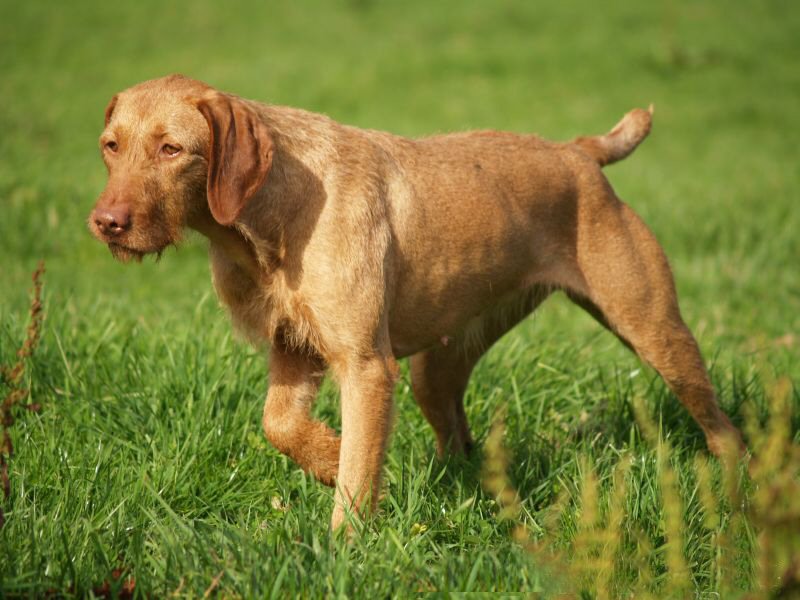
The dense, close outer layer is harsh rather than glossy, supported by water-repellent undercoat. Strong eyebrows and a short beard create the characteristic expression. The standard values an outline that remains visible beneath the hair, with colour in russet and dark sandy-gold shades.
Affection and purposeful searching
The breed description combines attachment to the handler with independent persistence when searching. It explicitly rejects rough treatment as a useful approach. Reward-based training, secure opportunities to explore and practice of calm everyday skills make more sense than expecting affection alone to provide reliable recall.
Care in daily life
Check the beard after meals and feel for debris around feet, chest and equipment contact areas after walks. Introduce face and foot handling gradually. A groomer can help agree how to maintain this individual wire coat, including what can be managed comfortably at home and when professional help is needed.
Plan comfortable care
Our gentle coat-care guide and first grooming appointment guide help you prepare questions about handling, maintenance and a suitable service. This breed profile is independent of named businesses.
Photograph and sources
The photograph illustrates one Wirehaired Vizsla. See the linked credit for its creator, source and reusable licence. It does not establish the dog's health, age or temperament.
Read the FCI catalogue entry and FCI breed standard. General care and handling guidance is available from PDSA and Dogs Trust.