
A companion's journey from China to European courts
The Pug's earliest ancestry includes uncertainty, which the FCI acknowledges rather than presenting a perfectly documented family tree. The catalogue records China as origin and Great Britain as patronage. Both FCI and Royal Kennel Club accounts describe dogs reaching the Netherlands through trade and later attracting interest in British court circles. Their role was companionship, not a smaller version of a cattle dog or a hunting specialist. The compact body and expressive face made a strong impression, but appearance alone is a poor way to assess a dog's comfort or suitability for a household. China is the historical origin filter here, not a statement that most Pugs now live there.
Living with the individual dog
Company, gentle play, suitable walks and opportunities to learn can all matter to an individual Pug. Small size does not remove the need for training, rest and patient preparation for time alone. Adjust activity to the dog and conditions, taking particular care with heat and strenuous exertion. Do not dismiss noisy breathing as a charming breed feature: Cambridge's veterinary guidance explains that breathing noises can indicate airway obstruction. Talk to your vet about breathing concerns and an appropriate assessment. A photograph, muzzle measurement or cheerful expression cannot diagnose a dog's airway function.
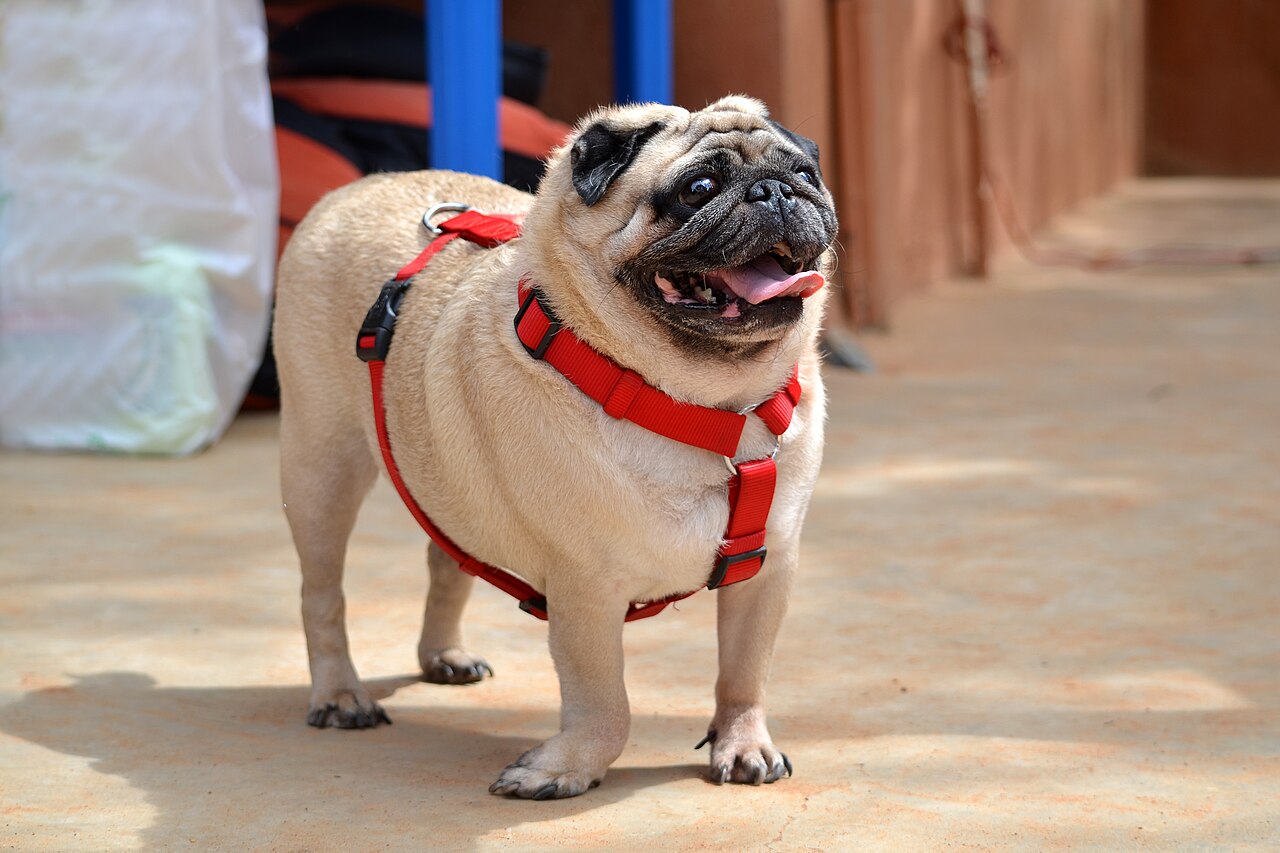
About the photograph: A naturally photographed fawn Pug wearing a harness. This image illustrates one individual and does not establish healthy breathing or recommend a particular body shape or harness fit.
Further reading: Royal Kennel Club Pug history and care guide; University of Cambridge guidance on recognising breathing difficulties.