
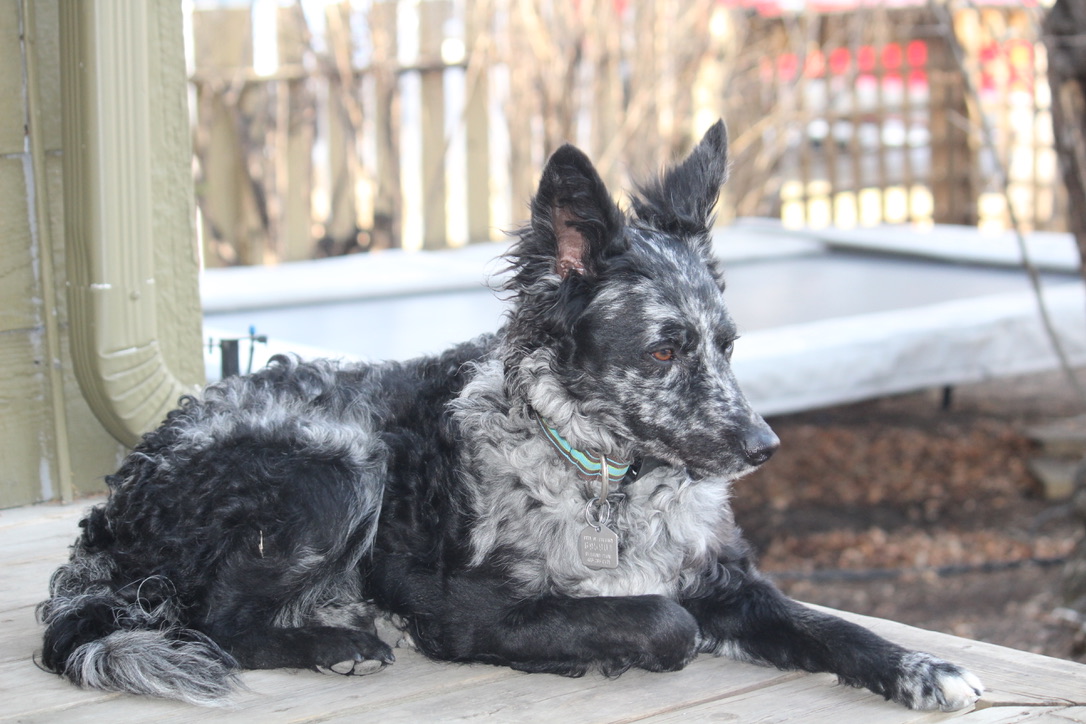
A Hungarian herding identity
The Mudi developed among Hungarian working herding dogs. The FCI places its formation in the eighteenth and nineteenth centuries and considers influence from prick-eared German herding dogs likely. That is a historical account of development rather than a precise, documented recipe of crosses.
Its useful identity lies in an alert, mobile dog able to learn and respond during pastoral work. The Mudi is distinct from the Puli and Pumi, even though all three have Hungarian herding connections. The coat and erect ears provide more helpful comparisons than a generic label of curly sheepdog.
Smooth hair meeting waves and curls
The head and fronts of the legs carry short straight hair, contrasting with the wavy or lightly curled body jacket. Longer hair occurs around the rear and tail. Several colours are recognised in the current standard; merle is one permitted pattern and does not define the whole breed.
Alertness needs a useful direction
The standard emphasises liveliness, adaptability and willingness to learn. Build predictable routines that include appropriate activity, rewarding cooperation and rest. An intelligent dog is not automatically self-training, and the individual's response to moving animals or unfamiliar situations still needs observation and management.
Following the actual coat texture
Check places beneath equipment and around the rear for retained plant material before it compacts. Gentle maintenance should preserve comfort rather than force a fluffy finish. Ask a groomer to explain suitable tools for the dog's real jacket and investigate painful skin rather than repeatedly brushing over it.
Plan comfortable care
Our gentle coat-care guide and first grooming appointment guide help you prepare questions about handling, maintenance and a suitable service. This breed profile is independent of named businesses.
Photograph and sources
The photograph illustrates one Mudi. See the linked credit for its creator, source and reusable licence. It does not establish the dog's health, age or temperament.
Read the FCI catalogue entry and FCI breed standard. General care and handling guidance is available from PDSA and Dogs Trust.