
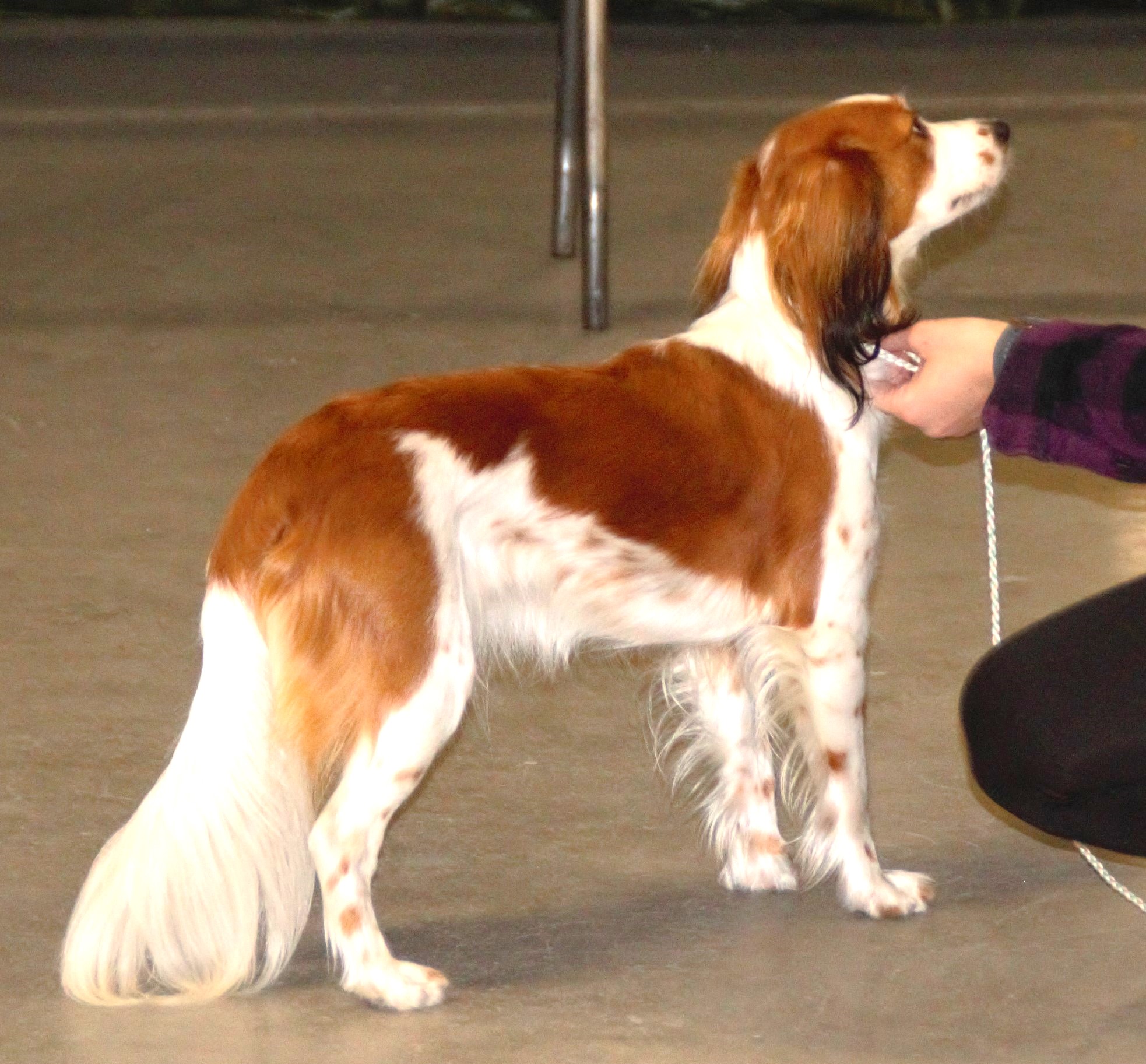
The dog beside the duck decoy
The Kooikerhondje's traditional work took place around Dutch duck decoys. Moving between screens with a waving tail, the dog attracted ducks' curiosity and helped draw them towards a trapping channel. It was not simply retrieving a duck after a shot; the movement itself formed part of the method.
Modern breed preservation owes much to Baroness van Hardenbroek van Ammerstol, who began searching for surviving examples in 1942. A Friesland bitch called Tommy became an important foundation dog. Provisional Dutch recognition followed in 1966, with official recognition in 1971, giving the present breed a documented revival story.
Orange-red patches and fine furnishings
The medium-length jacket is straight or slightly wavy over an undercoat. Orange-red patches contrast with white, while dark hair at the ear tips forms the distinctive earrings. Leg and tail feathering add interest without turning the breed into a uniformly long-coated dog.
A cheerful working background
The standard describes an attentive and energetic sporting dog. Patience and perseverance mattered in decoy work, but a breed ideal cannot predict a particular dog's recall or reaction to unfamiliar animals. Reward cooperation and introduce new settings at a pace the individual can manage.
Care for the feathered areas
Check behind ears and along tail and leg furnishings before small knots become tight. Fine ear-tip hair deserves gentle handling rather than pulling for a particular outline. Explain outdoor routines and sensitivities to a groomer so maintenance can remain comfortable and practical between appointments.
Plan comfortable care
Our gentle coat-care guide and first grooming appointment guide help you prepare questions about handling, maintenance and a suitable service. This breed profile is independent of named businesses.
Photograph and sources
The photograph illustrates one Kooikerhondje. See the linked credit for its creator, source and reusable licence. It does not establish the dog's health, age or temperament.
Read the FCI catalogue entry and FCI breed standard. General care and handling guidance is available from PDSA and Dogs Trust.