
Two sizes within one French breed
The FCI history credits Count Joseph de Carayon-Latour with crossing surviving Saintonge hounds with Bleu de Gascogne lines in the mid-nineteenth century. The resulting Great Gascon Saintongeois combined those regional traditions.
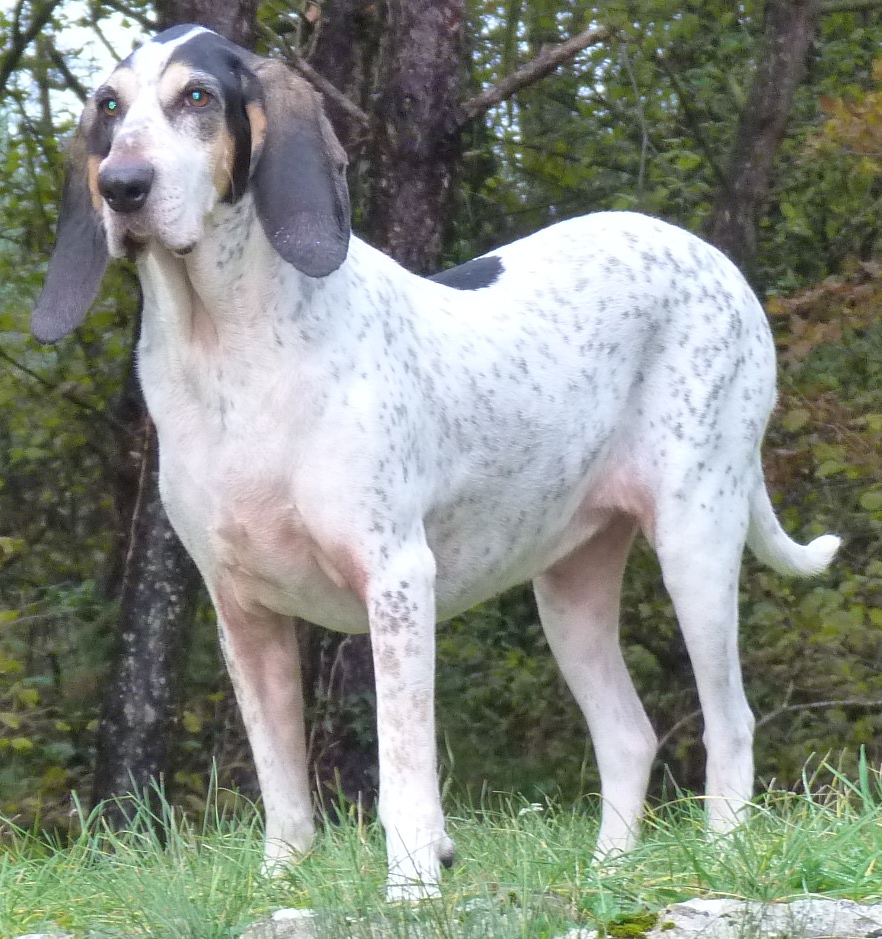
In the mid-twentieth century, hunters in south-west France selected smaller dogs to develop the Small or Petit variety, originally for hare work. Both varieties sit within FCI number 21. The photographed dog is identified as a Petit, so it should not be used as a precise guide to Great-variety dimensions.
The four-eyed expression
Black head patches contrast with pale tan marks above the eyes and around the cheeks, producing the traditional four-eyed description. The body is principally white with black patches and possible speckling. These markings are characteristic without acting as a pedigree test on their own.
A voice and a nose for work
The standard describes a fine nose, a wide search and a strong, carrying voice. In a household, ask about those interests alongside social experience and settling. Reward contact and provide secure exploration rather than assuming a calm breed ideal means little drive.
Routine care after the walk
Use gentle grooming to remove loose hair and feel for rubbing beneath collars or harnesses. Check feet and the outside of long ears for debris. Short, rewarded handling sessions and a stable surface help make professional care more comfortable and predictable.
Plan comfortable care
Our gentle coat-care guide and first grooming appointment guide help you prepare questions about handling, maintenance and a suitable service. This breed profile is independent of named businesses.
Photograph and sources
The photograph illustrates one Gascon Saintongeois. See the linked credit for its creator, source and reusable licence. It does not establish the dog's health, age or temperament.
Read the FCI catalogue entry and FCI breed standard. General care and handling guidance is available from PDSA and Dogs Trust.