
The changing story behind that unmistakable head
A Bull Terrier is often recognised before its name is spoken: the long, curved profile and compact, muscular outline are distinctive. Its history is less tidy than a single famous silhouette. Bulldogs and terriers were crossed in nineteenth-century Britain for activities that included animal fighting. That is part of the breed's background, rather than a reason to judge a present-day dog's behaviour from appearance alone.
James Hinks, working in Birmingham, helped establish the modern type in the middle of that century. The FCI history places an important public appearance at Birmingham in 1862 and the formation of the Bull Terrier Club in 1887. Early white dogs were followed by the development of coloured lines. Accounts propose several additional ancestral influences; they do not justify presenting one exact founding mixture as settled fact.
This profile covers FCI standard 11, the Bull Terrier. The Miniature Bull Terrier has its own FCI entry, so the two should not be merged simply because photographs can look similar. Great Britain in the origin filter describes the breed's development; it is not a claim about where most Bull Terriers live now.
Living with the individual dog
The standards and kennel-club descriptions emphasise an engaged, spirited companion. In ordinary life, ask what that means for the particular dog in front of you: how do they greet visitors, play with toys, settle after activity and respond when someone touches a paw? Those answers are more useful than assuming that every Bull Terrier is either a comedian or a handful.
Make room for learning as well as movement. Short, rewarding sessions can practise releasing a toy, standing on a mat and accepting a gentle brush. Give the dog a clear finish to the activity and a comfortable place to rest. A powerful body is not an invitation to use force during handling; arrange manageable introductions and supervise interactions with children and other animals.
A small grooming routine still deserves attention
A short coat makes the maintenance task different from that of a long-coated dog, rather than removing it. Use brushing time to learn what relaxed handling looks like for your own dog. If a previously comfortable brush stroke becomes unwelcome, pause and check what has changed instead of pressing on.
Before a professional visit, describe the dog's experience with baths, drying, feet and unfamiliar rooms. Ask which tasks are actually needed and how breaks will work. You can agree a practical appointment without choosing an elaborate trim. For more help, read our gentle coat-care guide and first-appointment guide below.
Read our gentle coat-care guide for help with home maintenance, and our first grooming appointment guide for questions to ask before a visit.
About the photograph and sources
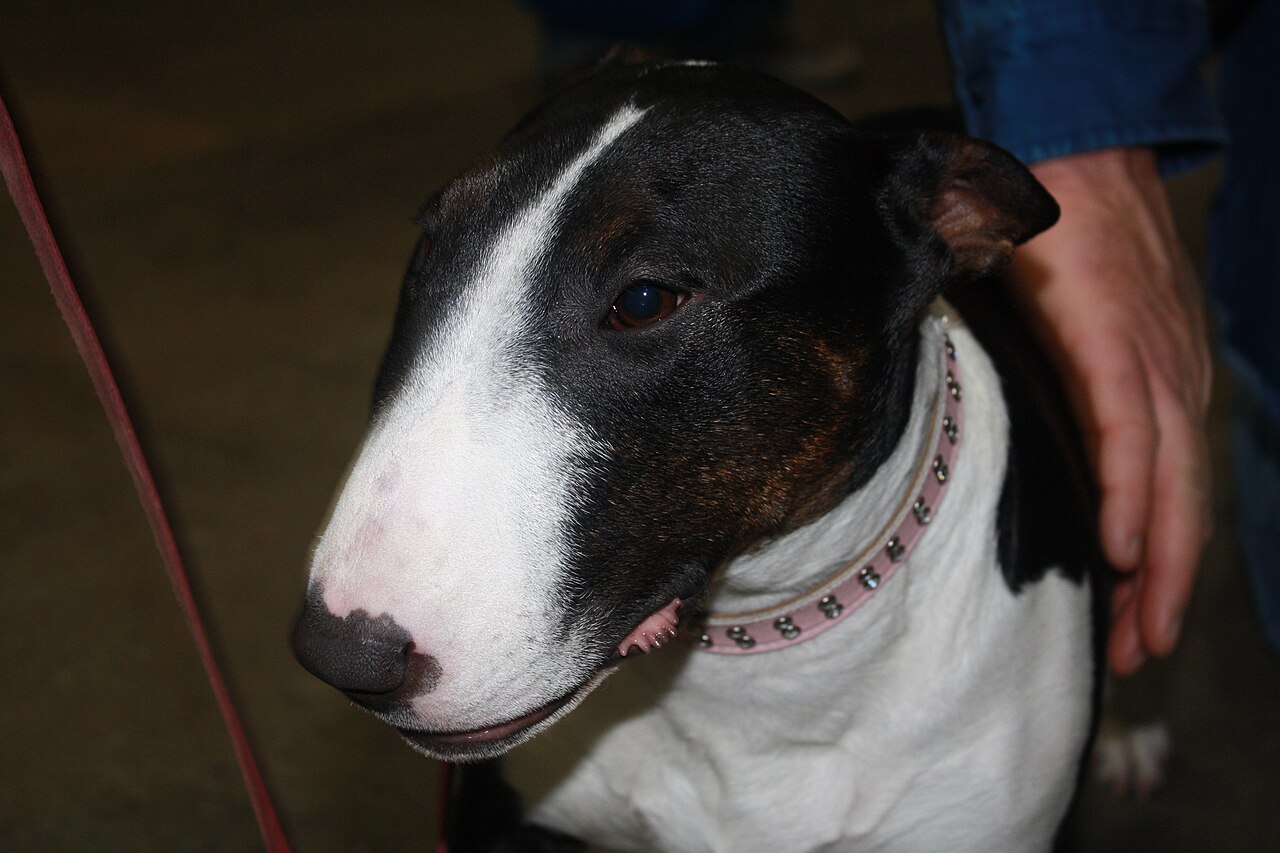
This natural close portrait shows one coloured Bull Terrier with a white facial blaze. It illustrates the head and short coat, rather than the whole body or the white variety. A still image cannot establish the dog's age, health or temperament.
Further reading: Royal Kennel Club breed guide; American Kennel Club breed guide; PDSA grooming guidance; Dogs Trust handling guidance.